The Ultimate Safety Shoes Size Chart for Men - Find Your Perfect Fit
Selecting the correct safety shoes size chart for men is essential for procurement managers and HSE officers managing industrial workforce safety across Saudi Arabia. Proper foot fit directly impacts employee comfort, daily productivity, and compliance on demanding job sites like manufacturing plants, oilfields, and construction projects. Understanding how protective toe caps and industrial soles affect shoe fitting enables companies to eliminate sizing errors and reduce costly product returns.
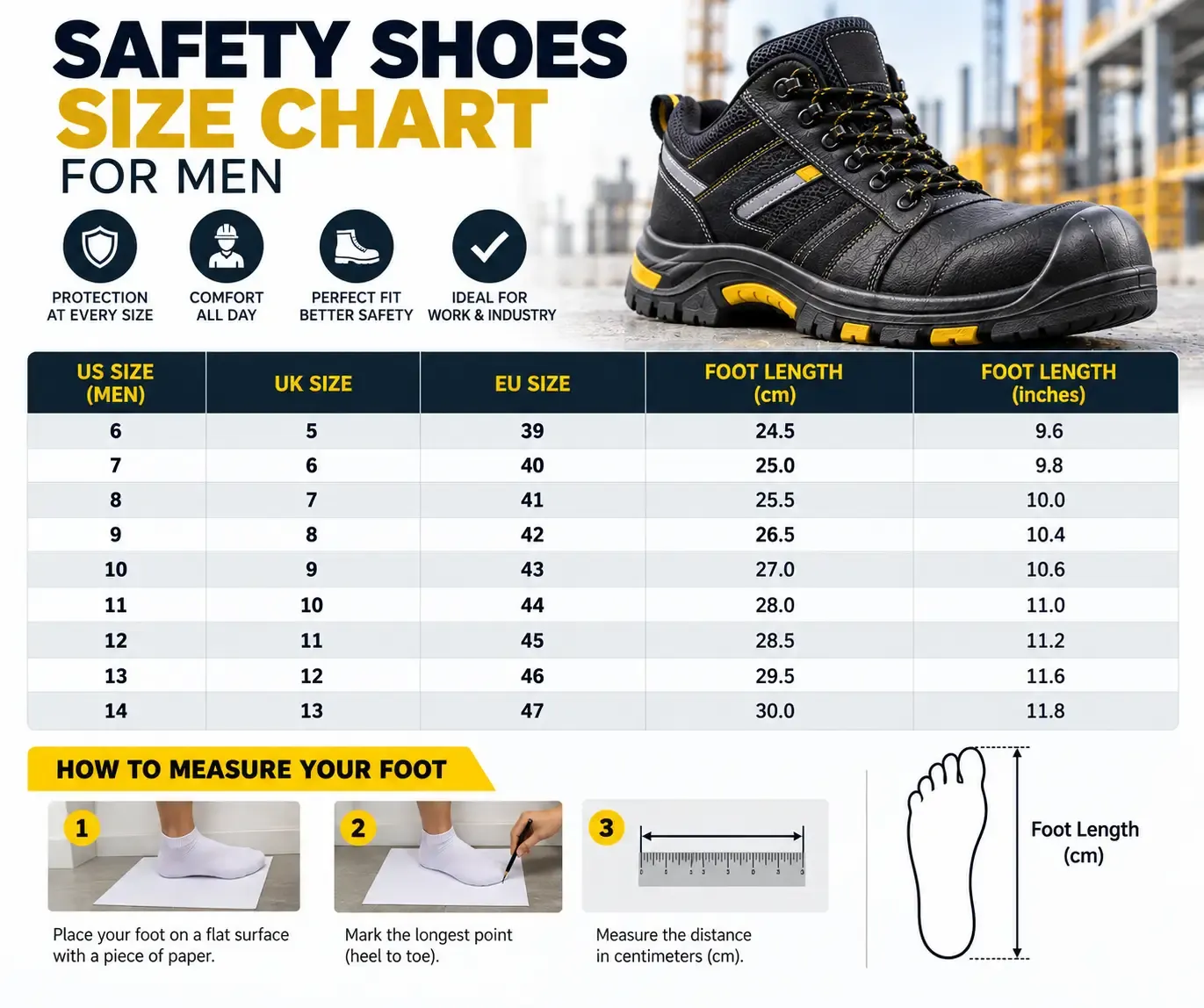
Safety shoes size chart for men - EU, UK, US and Mondopoint
Referencing a standardized safety shoes size chart for men ensures correct fitting for corporate procurement orders and workforce equipment deployment. Professional industrial safety footwear in Saudi Arabia typically uses European (EU) sizing conventions alongside UK, US, and mm/Mondopoint standards to maintain international sizing accuracy across all safety toe cap models.
|
EU Size |
UK Size |
US Size (Men's) |
Foot Length (mm / Mondopoint) |
Foot Length (Inches) |
|
39 |
6 |
6.5 |
245 |
9.6 |
|
40 |
6.5 |
7 |
250 |
9.8 |
|
41 |
7.5 |
8 |
260 |
10.2 |
|
42 |
8 |
8.5 |
265 |
10.4 |
|
43 |
9 |
9.5 |
275 |
10.8 |
|
44 |
9.5 |
10 |
280 |
11.0 |
|
45 |
10.5 |
11 |
290 |
11.4 |
|
46 |
11 |
11.5 |
295 |
11.6 |
|
47 |
12 |
12.5 |
305 |
12.0 |
Read more: Oil and gas safety footwear price
How to Measure Your Foot Correctly in Two Minutes?
Using a safety shoes size chart for men effectively requires taking precise foot measurements before placing bulk workforce orders. Taking accurate measurements prevents sizing errors, reduces exchange delays, and ensures immediate compliance and comfort across industrial job sites.
Follow these simple steps to measure foot length accurately:
-
Prepare the Tools: Place a blank sheet of paper flat on the floor against a straight wall, and wear the standard work socks used on shift.
-
Mark the Foot: Stand firmly on the paper with your heel resting flat against the wall. Mark the furthest tip of your longest toe using a pencil held straight up.
-
Measure the Length: Use a ruler or measuring tape to measure the distance from the edge of the paper (heel) to the pencil line (toe) in millimeters.
-
Compare and Match: Match the millimeter measurement (Mondopoint) against the standardized conversion table to select the correct European (EU) shoe size.
Why Safety Shoes Fit Differently From Regular Shoes?
Understanding a safety shoes size chart for men requires recognizing that industrial protective footwear behaves differently than daily athletic or casual shoes. Industrial boots are built with rigid protective components that do not stretch over time, making exact initial fitting critical.
Key construction factors that alter safety footwear fitting include:
-
Fixed Protective Toe Caps: Steel and composite toe caps create a rigid internal cavity that never stretches or expands. Workers need a minimum 5–10 mm clearance in front of the toes to prevent painful impact during walking.
-
Internal Puncture Plates: Integrated steel or Kevlar midsoles restrict longitudinal sole flex, requiring precise arch alignment to prevent midfoot strain.
-
Thicker Industrial Work Socks: Safety boots are designed to accommodate heavy duty moisture wicking or cushioned work socks, which add extra volume compared to thin dress socks.
-
Insole and Arch Inserts: Industrial orthotic insoles and shock absorbing inserts reduce internal volume, often requiring half a size larger for wide footed personnel.
Read more: Esd safety shoes saudi arabia price
Width: The Missing Half of Your Size
Consulting a safety shoes size chart for men only covers linear foot length, but foot width plays an equally crucial role in achieving a proper industrial fit. Selecting the correct width prevents lateral foot compression, skin abrasions, and long term musculoskeletal discomfort during extended shifts on hard surfaces.
Essential width considerations for industrial footwear include:
-
Standard vs. Wide Fitting: Most safety shoes come in standard width (EE or Wide), but workers with broad feet require wide-fit toe boxes to prevent the pinky toe from rubbing against the rigid composite or steel toe cap.
-
Toe Cap Clearance: A narrow toe cap forces toes into a unnatural position, leading to painful blisters, ingrown toenails, and reduced blood circulation.
-
Volume Adjustments: Utilizing adjustable lacing systems or dual-density insoles helps customize the internal volume for workers with high insteps without compromising toe clearance.
Read more: Guide to Aramco Approved Safety Shoes in Saudi
Sizing Mistakes That Cost Money
Applying a safety shoes size chart for men incorrectly during corporate procurement leads to costly returns, delayed site deployment, and lost productivity. Avoidable sizing errors directly impact operational efficiency and employee safety compliance.
Common B2B procurement sizing mistakes include:
-
Ordering Based on Casual Shoe Sizes: Relying on athletic shoe sizes often leads to undersized safety boots, as protective caps and heavy work socks require dedicated fitting criteria.
-
Ignoring Foot Swelling During Shifts: Feet naturally expand throughout an 8 to 12 hour shift due to heat and prolonged standing; sizing shoes too tightly causes severe end of day discomfort.
-
Skipping On Site Sample Fitting: Ordering large bulk batches without providing physical sizing sets or wear test samples increases the rate of size exchanges and administrative overhead.
-
Neglecting Half Sizes and Width Variations: Forcing staff into nearest full sizes instead of selecting proper width alternatives leads to higher rates of foot fatigue and workplace injury claims.
Read more: Guide to Types of Safety Shoes and Their Uses
Ordering Safety Footwear for an Entire Workforce
Implementing a safety shoes size chart for men across large industrial teams requires a reliable, local manufacturing partner capable of handling high-volume procurement smoothly. Sourcing directly from SLIC inside Saudi Arabia eliminates the logistical friction, sizing delays, and heavy shipping costs associated with international safety footwear brands:
-
Complete Size Range Availability: Supply your entire workforce effortlessly with full size runs from EU 39 to EU 47, ensuring every technician, engineer, and laborer receives a precise, compliant fit.
-
On Site Sizing Kits & Samples: Simplify corporate procurement by requesting physical trial samples directly to your facility prior to placing bulk contracts, minimizing post purchase exchanges.
-
Factory Direct Cost Savings: Enjoy highly competitive bulk pricing without distributor markups, customs duties, or long distance freight charges.
-
Rapid Regional Fulfillment: Maintain continuous site operations with fast local delivery and quick re order turnarounds for new hires and replacement cycles.
-
Certified Quality Standards: Every shoe is manufactured in full compliance with SASO, EN ISO 20345, and Aramco GI 8.005 specifications for immediate site clearance.
Call our B2B division at +966138121066 to obtain SASO and Aramco certification sheets, request full product catalogs, and secure immediate factory direct rates.
FAQ
What is the most accurate metric to use on a safety footwear size chart?
The Mondopoint system (foot length in millimeters) is the most precise metric because it measures exact foot length rather than arbitrary regional sizing increments.
Should workers select one size larger when buying safety shoes with steel toe caps?
No, workers should choose their true measured size unless they wear extra thick winter socks or orthotic insoles, as toe caps are pre engineered to allow essential toe clearance.
How much space should be left between the longest toe and the protective toe cap?
A clearance of 5 mm to 10 mm (about a finger's width) is recommended to prevent toes from sliding into the cap during downhill movement or forward impact.
Are European (EU) safety shoe sizes identical across all manufacturers?
While EU sizes are standardized, fit variations occur due to last shapes, internal sole thickness, and toe cap volume; testing physical samples is recommended for bulk orders.
How do wide fitting safety shoes differ from standard widths?
Wide fitting models offer additional volume across the ball of the foot and a wider toe cap perimeter without increasing the overall heel-to-toe length of the shoe.
Conclusion
Selecting the correct protective footwear size requires matching precise millimeter foot measurements with standardized international conversion tables while accounting for fixed toe cap clearance. Ensuring an accurate initial fit across your workforce prevents site injuries, reduces fatigue, and eliminates unnecessary exchange costs during corporate procurement cycles.
Partnering directly with a established Saudi manufacturer like SLIC simplifies bulk workforce sizing through localized fitting samples, full EU size availability, and fast regional fulfillment that keeps industrial operations fully compliant and running smoothly.
- Hits: 36
